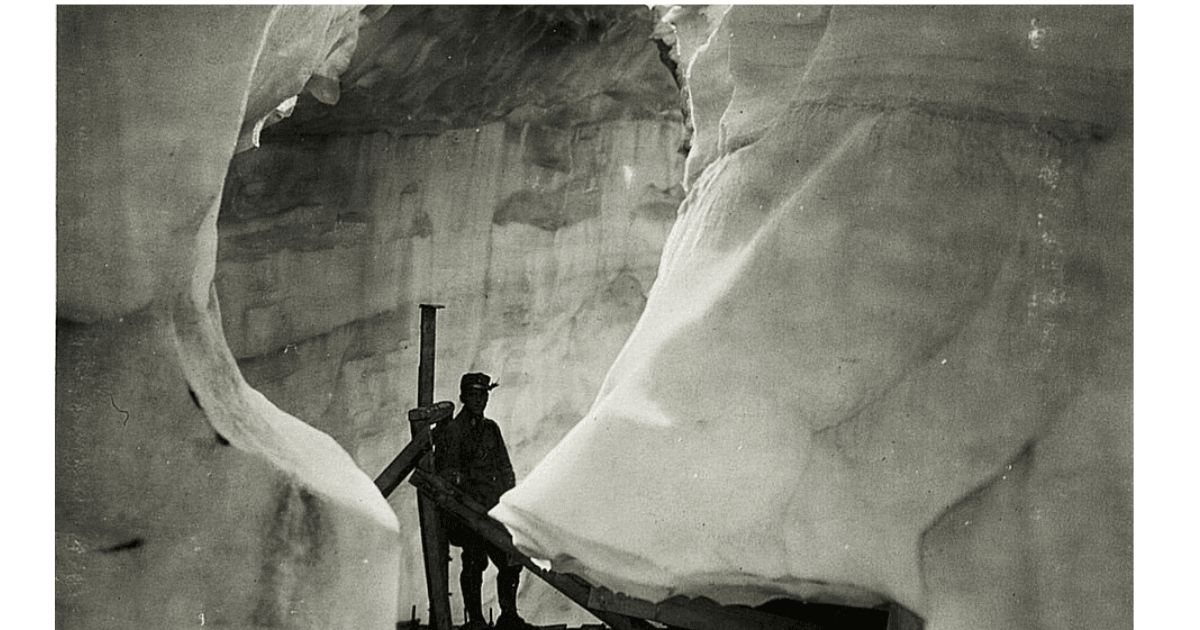
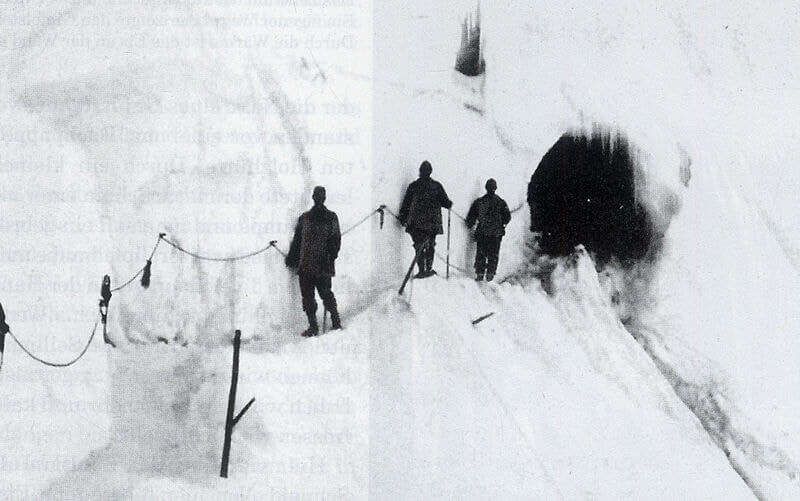
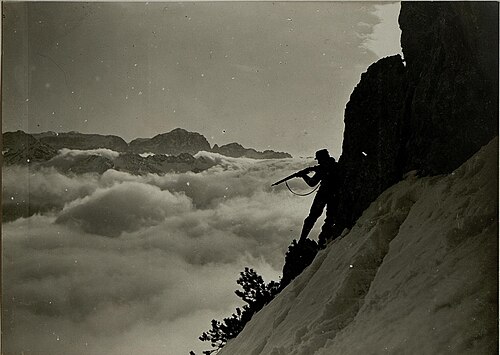
Cover photo: An Austrian soldier on the so-called “Bridge of Sighs,” in the Austrian tunnels beneath the Marmolada Glacier, 25 September 1917. Source: Austrian Digital Library
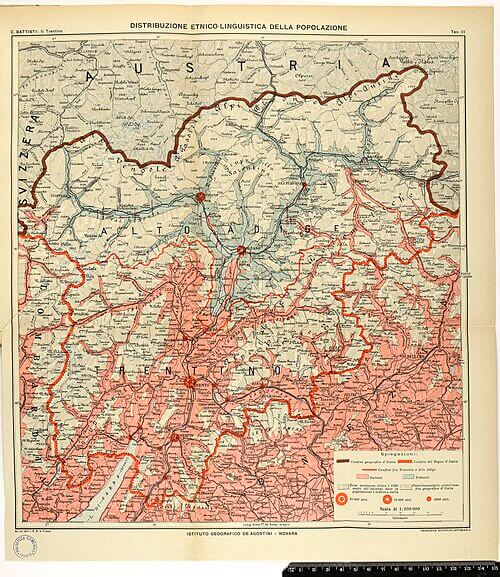
The expression “White War” (Italian: Guerra Bianca, German: Gebirgskrieg), or Alpine Front, refers to the military operations that took place in the Alpine sectors of the Italian Front during the First World War. On this front, battles were fought in mountains of medium and high elevation, along the southern Alpine regions of historical Tyrol and the adjacent Italian territories, where much of the terrain consists of mountain ranges exceeding 2,000 metres and reaching elevations of up to 3,905 metres.
From the first months, the Alpine front became increasingly static in many sectors. Fortified lines were constructed wherever the terrain permitted, with trenches, shelters, artillery positions and tunnels covering important gaps and approaches. Even high peaks and ridges were occupied and fortified when strategically useful, creating mutually supporting defensive positions. Conventional frontal attacks remained possible, but they were extremely difficult and costly in such terrain. Consequently, warfare increasingly involved small-unit actions, often at patrol or company level, together with artillery bombardments and underground warfare.
This was particularly evident in the Dolomite sector of northeastern Italy, where both armies constructed extensive tunnel systems and, in some locations, placed explosives beneath enemy positions. The purpose was not simply to blow up entire peaks, but to destroy specific defensive positions, galleries and sections of rock occupied by enemy troops. Some of these explosions were enormous and permanently altered the landscape. This form of warfare continued until the Italian positions in the Dolomites and Cadore were abandoned during the general retreat following the Austro-Hungarian offensive at Caporetto in October 1917, when Italian forces withdrew toward the Piave and Monte Grappa.
The character of the fighting became apparent when Italy declared war on Austria-Hungary on 24 May 1915. Several battalions from the forces stationed between San Candido and the Stelvio were deployed toward Monte Piana and its surrounding valleys. Monte Piana formed part of the operational sector of the Italian Fourth Army, commanded by Lieutenant General Luigi Nava. On 24 May, two platoons of the 96th Company, Pieve di Cadore Battalion, 7th Regiment, occupied positions on Monte Piana. Other Alpini of the 67th Company were hit by an artillery shell at around 08:30. They were among the first Italian soldiers killed in the Alpine fighting.
Monte Piana subsequently became one of the most heavily contested positions in the Dolomites. The mountain was divided between the two armies: the Italians occupied Monte Piana to the south, while the Austro-Hungarians held Monte Piano to the north. Over the following two years, repeated attacks, artillery bombardments and small-unit actions produced enormous casualties while causing relatively little change to the front line. Approximately 14,000 casualties are often associated with the fighting around Monte Piana on both sides, although this figure should be regarded as an approximate estimate rather than a precise death toll.
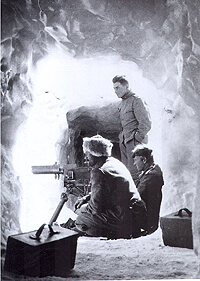
Farther southwest, at Monte Cristallo, a similarly static situation developed, with unsuccessful attacks by both sides and survival in the extreme environment becoming an essential factor in maintaining the line. On 27 November 1915, for example, Italian Bersaglieri taking part in an attack in the sector suffered heavy losses from combat and the extreme cold, with contemporary accounts recording hundreds of men dying from exposure and freezing conditions.
At the eastern end, around Croda Rossa di Sesto, Austro-Hungarian troops succeeded in occupying important positions with the assistance of a small detachment of German mountain troops. On 7 July, however, Italian artillery destroyed the Zsigmondy refuge. In August, Italian troops occupied the upper Fiscalina Valley and advanced toward the Zsigmondy ridge. Despite the enormous difficulties created by the terrain, altitude and weather, they eventually captured the 3,042-metre summit of Monte Popera.
Other important positions included the precipitous Tre Cime di Lavaredo and Sasso di Sesto, where small groups of mountaineers and skiers from both armies fought for strategically important positions, as well as Col di Lana and the Falzarego sector.
One of the most spectacular examples of underground warfare occurred at Castelletto, in the Tofana sector near Cortina d’Ampezzo. After several unsuccessful attacks, the Italians constructed a tunnel approximately 500 metres long beneath the Austro-Hungarian position and filled it with around 35 tonnes of explosives. General Luigi Cadorna and King Victor Emmanuel III observed the operation from the Italian positions around Cinque Torri. On 11 July 1916, the mine was detonated, destroying a large part of Castelletto and killing approximately 150 Austro-Hungarian soldiers. The Italians subsequently captured the southern part of the position, although the fighting remained extremely difficult because of the unstable rock, debris and dangerous fumes created by the explosion.
A similar operation was carried out the following year at Piccolo Lagazuoi, near Falzarego Pass. On 20 June 1917, the Italians detonated approximately 32–33 tonnes of explosives in a tunnel system roughly one kilometre long beneath the 2,668-metre mountain. By the time of the explosion, however, the Austro-Hungarian troops had already withdrawn from the threatened summit position. The Italians occupied the resulting crater area, but the Austro-Hungarian forces remained in strong defensive positions and halted further advances with artillery and machine-gun fire. The explosion nevertheless became one of the most dramatic examples of the underground warfare that characterized the White War in the Dolomites.
Another front was the Adamello–Presanella sector, which lay on the western edge of the front. Here, unlike in the Dolomites and elsewhere, the Italian troops did not withdraw after the defeat at Caporetto, and fighting continued into 1918. The main operation of that year in this sector, known as the “White Battle,” took place between 25 and 28 May. Seven battalions of Italian troops, together with the elite Arditi, machine-gunners and approximately 200 artillery pieces, attacked and captured the Presena Glacier and the nearby peaks.
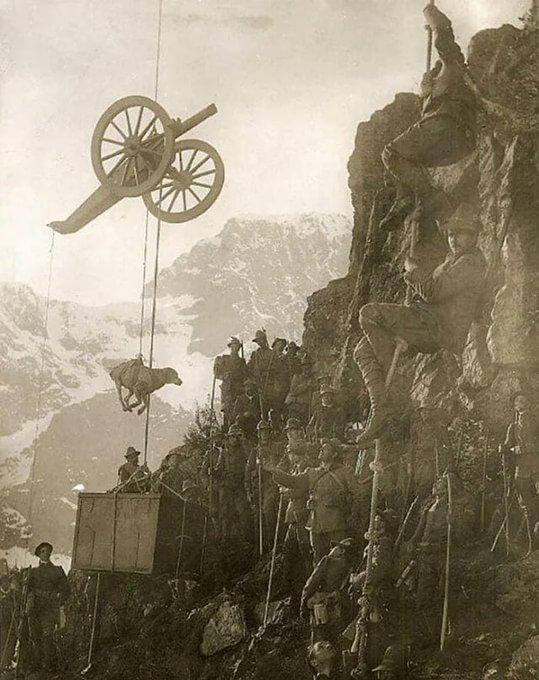
Finally, the most precipitous sector of all those mentioned above was the Ortler–Cevedale sector. The peaks there were, on average, 500 metres higher than those in the other sectors and presented some of the most extreme conditions of all the Alpine battlefields. The terrain was also unusually hard, making the construction of trenches and tunnels extremely difficult. These conditions made it almost impossible for either side to launch a decisive offensive, and the front remained largely static. The largest confrontation there was the Battle of San Matteo, which took place in 1918, from 13 August to 3 September, at Punta San Matteo (3,678 metres). It is generally regarded as the highest-altitude battle of the First World War. The units involved were Italian Alpini from the 307th and 308th Companies of the “Monte Ortler” Battalion and Austro-Hungarian mountain infantry of the Kaiserschützen. The Italians captured the summit on 13 August, but an Austro-Hungarian counterattack recaptured it on 3 September. The final fighting resulted in the deaths of 17 Austro-Hungarian and 10 Italian soldiers.
As might be expected, the fighting was characterized above all by the overwhelming difficulties posed by the climate, snow and the supply problems faced by both armies. The enormous effort required to transport artillery to the mountain peaks was perhaps one of the most difficult undertakings of the entire White War, while the living conditions of the soldiers were probably among the harshest and most inhospitable of the entire war. The very nature of the high mountains, while providing natural shelter on the one hand, placed an enormous strain on the endurance of the soldiers on the other. They had to fight not only against the enemy but, above all, against the elements of nature. Huge seracs (massive and extremely dangerous blocks of glacial ice), violent snowstorms, constant avalanches, hunger and, naturally, persistent frostbite caused by temperatures that sometimes fell to 40 degrees below zero produced enormous numbers of casualties, in some circumstances exceeding those caused directly by combat. To a large extent, success in this section of the front depended on the ability and endurance of units to remain in their positions. Characteristic of this was the major battle around Monte Piana, in which approximately 14,000 casualties from both sides are often associated with the fighting between 24 May 1915 and 22 October 1917, while the front line remained almost unchanged.
In these high mountains, temperature fluctuations were considerable, and above 2,500 metres, temperatures below 0°C were normal even during summer. The winters of 1916 and 1917 were exceptionally snowy, with mountain slopes in some areas covered by snowpacks reaching eight metres, approximately three times the average. In order to maintain troops at high altitudes, soldiers were forced to dig through and continuously clear the snow.
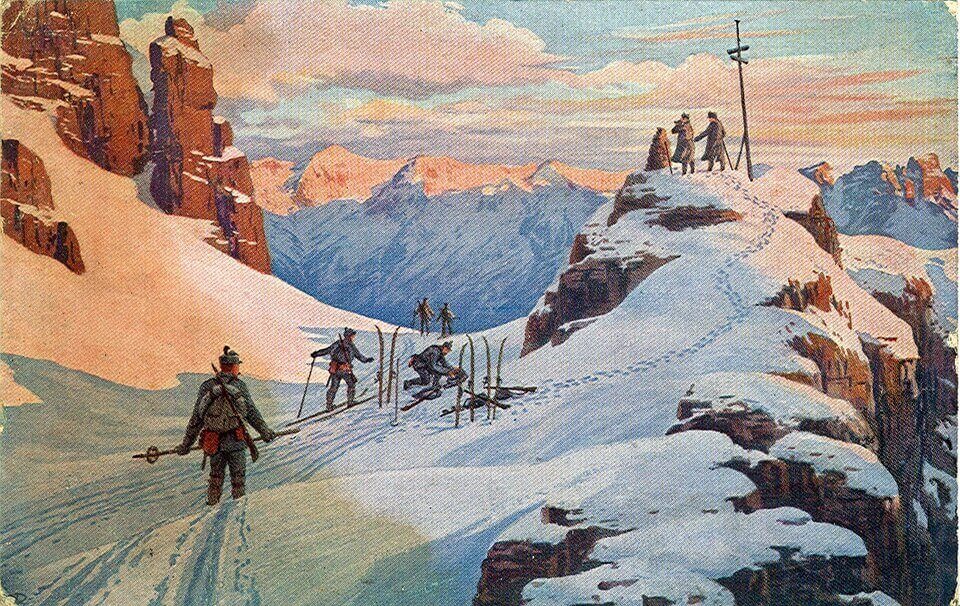
The historian Heinz Lichem von Löwenbourg stated that, based on the reports of the combatants, an approximate rule for the Alpine front in 1915–1918 was that two-thirds of the dead were victims of the elements of nature—frostbite, avalanches, illness and exhaustion—and only one-third were victims of enemy military action. This should be understood as Lichem’s historical estimate, rather than as a precise modern statistical calculation.
For example, on 13 December 1916, dozens of avalanches occurred following a sudden change in temperature. The avalanche disaster of December 1916 is regarded as one of the most catastrophic natural disasters of the Alpine war. Entire companies were buried beneath the snow. The precise number of victims remains uncertain, but modern research suggests that around 2,000 soldiers may have died in the avalanche disasters of 12–13 December, (there is an often-cited figure of 5,000). The First Battalion of the Kaiserschützen Regiment lost 230 men that day, while on the glacier at Marmolada, the highest mountain in the Dolomites, an avalanche killed between 270 and 332 men. Despite its scale, the disaster remained largely unknown, primarily because of military secrecy. In that area, the Austrians had excavated so many tunnels within the lower layers of the glacier that they called the position “the city in the ice” of Marmolada.
Unlike the Isonzo Front, where large numbers of men clashed, often including troops who were not particularly well trained, the “White War” was characterized by the relatively small number of men deployed in many Alpine positions, who were generally well trained and physically prepared, and by the fact that they were equipped with specialized equipment and technology intended to help them survive in such a hostile environment. Several specialized units distinguished themselves during the fighting, such as the Alpini Sciatori Battalion, commanded by Nino Calvi; the Arditi reconnaissance group of Val Zebrù; and the “Flying Patrol” associated with Joseph “Sepp” Innerkofler. Many of these men were experienced mountaineers, hunters and skilled marksmen. Once their objective had been determined, specialized Alpine units were often given considerable freedom of action.
Because of the enormous pressure, isolation and deprivation, both sides had to deal with disciplinary problems, including desertion. In the Austro-Hungarian Army, some Czech units in particular experienced problems with morale and discipline, although this varied considerably between units. Czech nationalism and the Entente’s support for the creation of a separate Czech political entity increasingly influenced some soldiers, while the poor supply situation of many Imperial and Royal forces further contributed to declining morale.
In the case of the Italian units, regional differences between northern and southern Italians could sometimes affect morale and cohesion, but the idea that southern Italians generally regarded the war simply as a “War of Rome and the North” would be too broad. Desertions and surrenders did occur among Italian troops, but their causes were varied and included exhaustion, poor conditions, fear, opposition to the war and individual circumstances rather than regional identity alone.
In one of the dozens of clashes, the Kaiserschütze (Austro-Hungarian imperial mountain infantryman) Heinz von Lichem wrote in 1916:
“Up there, winter had already begun by the end of September, not in silence and peace, […] but with the terrible war. […] the enemy did not even grant their own fallen their final rest. Hundreds of them remained in front of our barbed wire after the bloody attacks, and we had buried them where they fell. Large-calibre shells shook the ground day and night, reopening the graves…”
Sources:
G. Cadioli, “Enemies in High Places: The Battle for Mount Scorluzzo (1915–1918)”, 2022.
I. Voigt “The Alpine Corps on the Dolomite Front, 1915: Myth and Reality”, publ. Athesia, 2015.