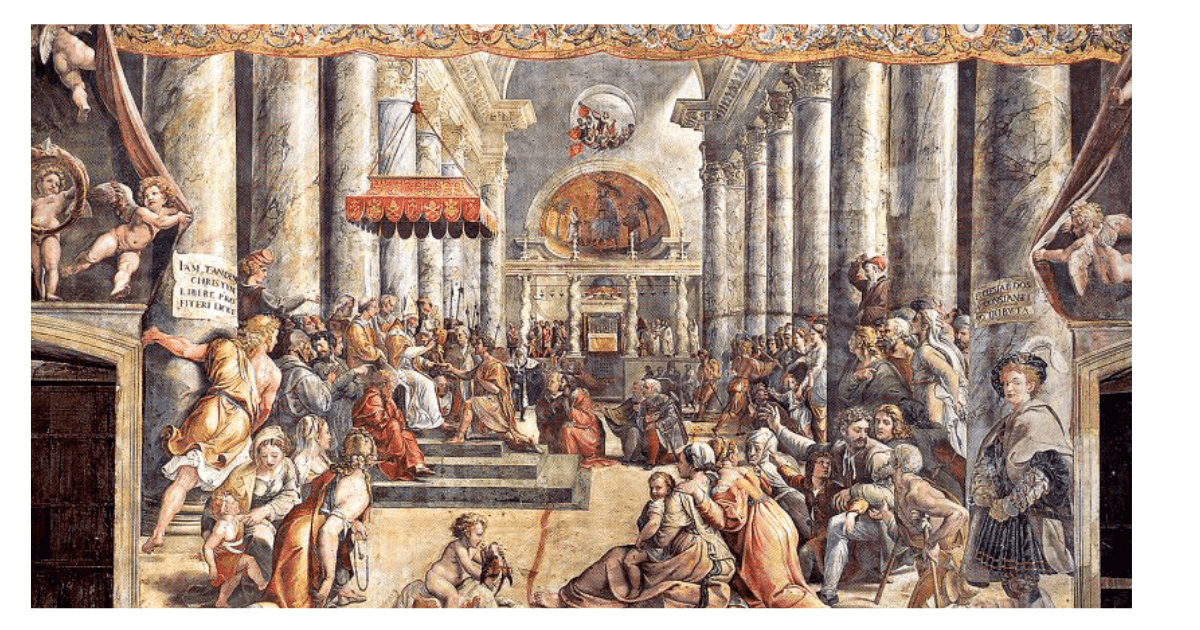
Cover image: The Donation of Constantine. A Renaissance fresco by Raphael’s assistants, painted around 1520–1524 in the Vatican. It depicts Constantine giving Rome to the Pope, based on a forged document. Sala di Costantino, Raphael Rooms, Apostolic Palace, Vatican City.
Among the documents that shaped medieval Europe, few had a longer political afterlife than the Donation of Constantine. For centuries, it was presented as proof that the pope possessed legitimate authority not only over spiritual matters but also over vast territories and imperial rights. Yet the document was not an authentic act of the Roman emperor Constantine the Great. It was a carefully constructed forgery, probably produced in the 8th century, and its exposure became one of the most important achievements of Renaissance historical criticism.
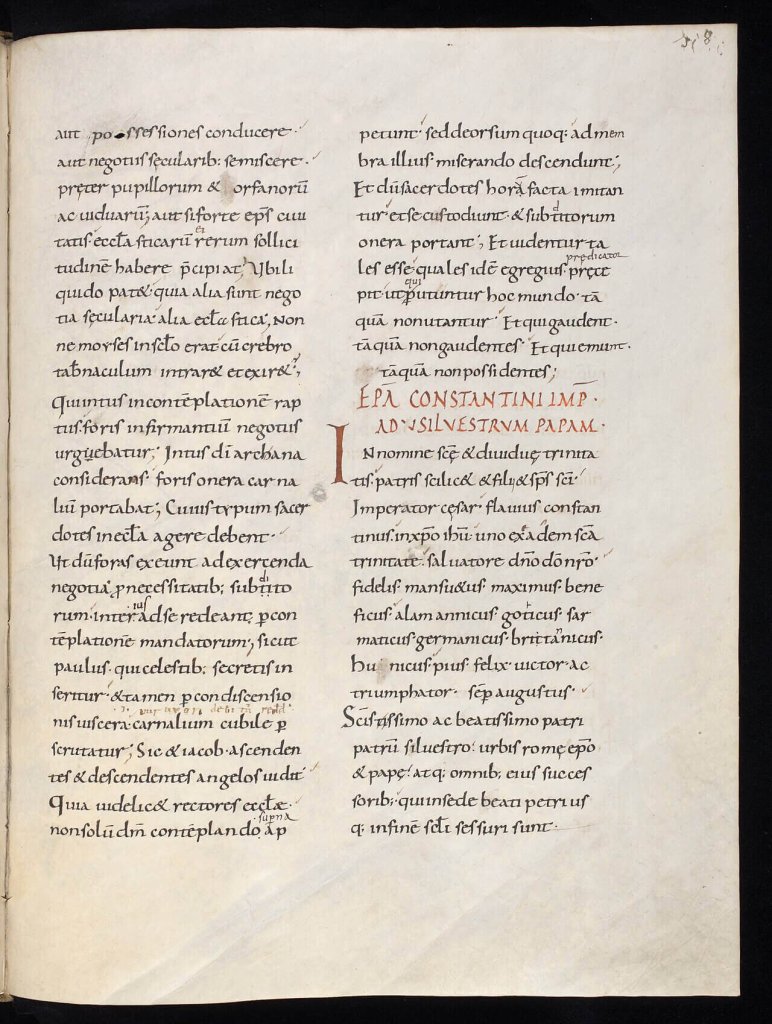
The Donation of Constantine claims that Emperor Constantine, after being cured of leprosy and converted to Christianity by Pope Sylvester I, granted the pope control over the city of Rome, the western provinces of the Roman Empire, and a position of superiority over all other churches (But Sylvester died in 335, while Constantine died in 337)1. The text also states that Constantine moved the imperial capital to Constantinople because he considered it inappropriate for a secular ruler to govern from the same city as the pope.
The document was designed to support a very specific political argument: that the papacy had inherited a form of imperial authority in the West. During the Middle Ages, this claim became especially significant in disputes between popes and secular rulers, particularly over the question of who held supreme authority in Christian Europe.
The forgery was most likely created in the middle of the 8th century, although scholars continue to debate the exact date and circumstances. The political environment of that period provides the most convincing explanation. The papacy was seeking greater independence from the Byzantine Empire, which still claimed authority over parts of Italy, while at the same time facing pressure from Lombard expansion. The alliance between Pope Stephen II and the Frankish ruler Pepin the Short, which led to the creation of the Papal States, occurred in this same context.
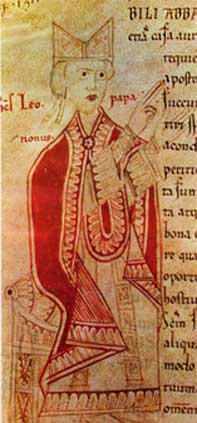
The earliest known use of the Donation appears in the 9th century, when it was incorporated into collections of canon law. However, the document did not immediately become the foundation of papal power. Its importance increased gradually, especially during the 11th and 12th centuries, when reforming popes used historical arguments to strengthen the independence of the Church from kings and emperors.
One of the most revealing aspects of the forgery is that it contains historical and linguistic mistakes that expose its later origin. The document uses administrative terms and concepts that did not exist in Constantine’s fourth-century Roman Empire. It refers to the pope as holding authority over imperial symbols and territories in a way that reflects medieval political ideas rather than late Roman practice. It also describes Constantinople as having a role that would only make sense after the city became the imperial capital in 330.
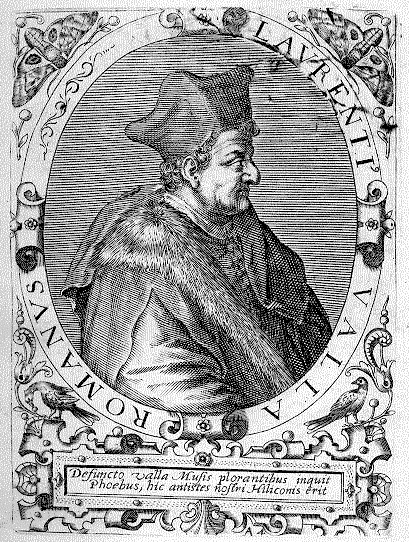
The decisive demonstration of its falsehood came from the Italian humanist Lorenzo Valla in 1439–1440. Working with the methods of Renaissance philology, Valla examined the Latin language of the document and showed that it could not belong to the age of Constantine. His analysis focused on vocabulary, grammar, and historical references. For example, he identified words and expressions that were common in medieval Latin but unknown in the fourth century.
Valla’s work was not simply an academic exercise. It challenged one of the strongest ideological foundations of papal political claims. His treatise, De falso credita et ementita Constantini donatione declamatio (“Discourse on the False Belief and Fabrication of Constantine’s Donation”), circulated widely and became a model for later historical criticism. Interestingly, Valla himself remained a Christian and a servant of the Church; his argument was directed against the misuse of a false document, not against religion itself.
The Donation of Constantine continued to influence European politics even after its exposure. The papacy did not immediately abandon all claims connected with it, but the intellectual climate had changed. The document became a famous example of how political power could be supported by invented traditions and how historical methods could be used to test official narratives.
A lesser-known detail is that the forgery was so successful partly because medieval societies did not approach documents in the same way modern historians do. Written texts often carried authority simply because they existed, especially when preserved within religious collections. The question of authorship, language, and historical context became central only with the rise of Renaissance scholarship.
The story of the Donation of Constantine is therefore not only the story of a false document. It is also the story of how historical knowledge developed. A text created to strengthen authority eventually became a landmark case in the study of authenticity, evidence, and the responsibilities of historians. Few forgeries have had such a long political life or played such an important role in the birth of critical historical method.
Sources
- https://archive.org/details/defalsocreditaetementitateubner
- Christopher B. Coleman (ed. and trans.), The Treatise of Lorenzo Valla on the Donation of Constantine (1922).
- Johannes Fried, Donation of Constantine and Constitutum Constantini: The Misinterpretation of a Fiction and Its Original Meaning (2007).
- Walter Ullmann, The Growth of Papal Government in the Middle Ages (1955).
- Geoffrey Barraclough, The Medieval Papacy (1968).
- Francis Oakley, The Conciliarist Tradition: Constitutionalism in the Catholic Church 1300–1870 (2003).
Footnotes
- According to the document, Constantine supposedly granted Pope Sylvester the Lateran Palace, Rome, Italy, and essentially the western territories of the Roman Empire.
Even more strikingly, Constantine is said to have handed over symbols of imperial authority — including the imperial diadem, purple robes, sceptre, spear, and military standards. ↩︎