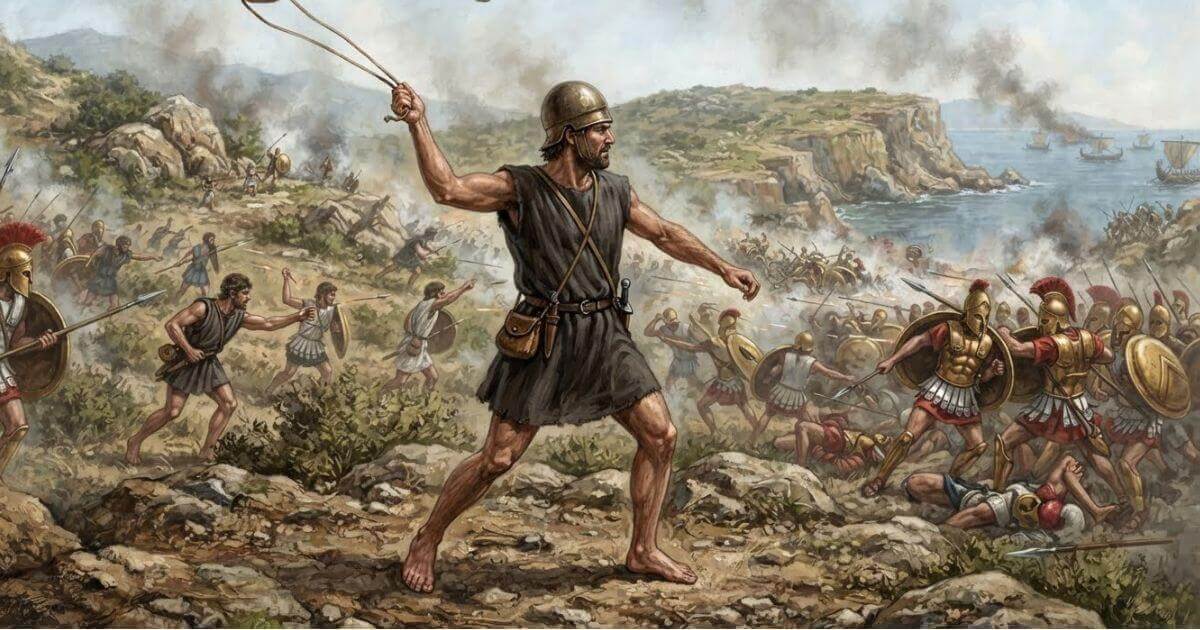
Cover image: Illustration depicting the Battle of Sphacteria in 425 BC. Spartan hoplites come under a relentless barrage from the numerous Messenian and Athenian light infantry, including slingers, archers and peltasts. Whenever the Spartans attempted to attack, their opponents easily evaded them, being far more lightly equipped and mobile. The desperate situation ultimately led to the Spartans’ surrender, an event that caused widespread astonishment throughout the Greek world.
During the Classical period, the heavily armed Greek hoplite was the dominant figure on the battlefield. However, alongside him were almost always lightly armed infantrymen who carried various missile weapons and supported the actions of the hoplite phalanx. Among them, the slingers stood out. Using a simple and inexpensive weapon, they participated in numerous battles and military campaigns, often providing valuable and decisive services. Although they enjoyed considerably less prestige than the hoplites, their presence proved particularly useful, especially when the terrain and tactical circumstances allowed their mobility to be exploited.
The sling, its projectiles, and its range
The use of the sling dates back thousands of years. Since the organic materials from which slings were made tend to decay, the earliest evidence comes mainly from iconography. Early projectiles have been discovered in the Greek world, while slingers are also depicted on a Mycenaean rhyton.

The sling’s main advantages were its minimal cost and ease of transportation. It consisted of two cords, usually made of leather, with a pouch in the middle to hold the projectile. In the Greek world, the most common technique involved rotating the sling horizontally above the head. Longer slings provided greater range, while shorter ones made accurate shooting easier.
The earliest projectiles were made of stone or fired clay. Smooth stones were often preferred, while clay projectiles allowed for more consistent control over their size and weight. From the late Classical period onward, lead projectiles came into wider use. These were usually ellipsoidal in shape and offered better aerodynamics, greater range, and increased lethality. They were cast in moulds and could be produced in large quantities. Some had cavities designed to produce a sound during flight and confuse the enemy. Others bore letters or symbols, including the names of owners and commanders, invocations to the gods, or mocking messages such as “Take this,” “Eat this,” and “Blood.”
Effective range depended on the slinger, the sling, and the projectile. An ordinary slinger could shoot at distances of 150–200 metres, while experienced Rhodian slingers were said to be capable of shooting considerably farther. Maximum range did not guarantee accuracy; distances of 120–200 metres were considered more suitable for the initial volleys.
Their role on the battlefield
In pitched battles, the slingers’ primary mission was to inflict as much damage as possible on the enemy before the close-quarters engagement began. At the same time, they supported other light infantry units and sought to reduce the effectiveness of enemy archers, javelin throwers, and slingers. To ensure they had enough room to rotate their weapons and shoot without hitting friendly troops, they were usually positioned in front of the hoplites. Positioning them on the flanks of the formation could also result in casualties among allied troops, while shooting from behind the phalanx would reduce the force of their projectiles.

Slingers could prove particularly effective in irregular warfare, using continuous harassment, rapid withdrawals, and every advantage offered by the terrain. Lightly equipped, they moved more easily than heavily armoured hoplites and could strike the enemy without engaging directly. In difficult terrain, they could even confront cavalry, while they were also useful during sieges, when ranged attacks were required. The sling was particularly dangerous partly because opponents found it difficult to identify the source of incoming projectiles in time.
Slingers in the Greek world
Slinger units often came from lower social classes or poorer city-states that lacked the financial resources to maintain large numbers of heavily armed hoplites. Many were shepherds, livestock herders, and farmers for whom the sling was a familiar and practical weapon. Historical sources do not always refer to them by the specific term slingers (sphendonētai, σφενδονήται), often classifying them instead as psiloi, meaning light infantry, or using terms such as gymnētes, referring to lightly equipped troops.
The tradition of sling use was ancient. Homer refers to the slings of the Locrians, while Plato includes slinging in the education of young men. In mainland Greece, from Acarnania to Phthiotis, the mountainous terrain and rural populations favoured its use. The Acarnanians and Rhodians, in particular, gained a reputation for their skilled and professional slingers.
From the Peloponnesian war to Sicily
Thucydides provides a characteristic account of the Acarnanians’ actions in 429 BC, when a Peloponnesian army attempted to advance against Stratus. An isolated enemy detachment was taken by surprise, after which the Acarnanians subjected it to a barrage of projectiles, preventing its men from moving safely even within their own camp. This episode demonstrates how effective slingers could be when they exploited confusion and advantageous positions.

At Sphacteria in 425 BC, the Athenians and Messenians deployed large numbers of light infantry against the Spartans. These lightly armed troops avoided close combat, withdrew when attacked, and continued firing stones, arrows, and javelins. Their constant harassment physically and psychologically exhausted the heavily armed Spartans and contributed to their surrender. At the Battle of Delium in 424 BC, slingers from the Malian Gulf reinforced the Boeotians during the siege of the Athenian forces.
During the Sicilian Expedition, the Athenians had approximately 700 Rhodian slingers. Nicias had pointed out their usefulness against the numerous enemy cavalry forces. The slingers participated in the initial clashes with the Syracusans and, alongside other light infantry, hurled projectiles at the opposing forces. During a naval engagement, the Syracusans also employed slingers, whose continuous volleys forced the Athenians to abandon the prows of their ships, facilitating attacks on and the capture of enemy vessels. In the Athenians’ final attempt to break through the blockade, their crews used every available missile weapon. Their defeat, however, led to disaster, and during the retreat overland, the surviving soldiers were subjected to continuous attacks by enemy light infantry.
From Piraeus to the army of Alexander the Great
Their role continued after the Peloponnesian War. At Piraeus in 403 BC, light infantry, slingers, peltasts, and archers put pressure on Spartan forces and forced them to retreat. During the siege of Motya in 398 BC, Dionysius I of Syracuse used slingers and archers to create a powerful barrage against the Carthaginians. At Nemea in 394 BC, at least 400 slingers from Elis took part in the fighting.
During Philip II’s siege of Olynthus in 348 BC, hundreds of lead projectiles were discovered, some bearing inscriptions with names associated with the king and his officers. Finds bearing inscriptions referring to the Olynthians and the Chalcidians indicate that slingers also served on the defenders’ side.

Alexander the Great employed slingers during his campaigns in the Balkans and Asia. Against the Thracian tribe of the Triballi, their projectiles helped force the enemy to abandon a wooded ravine and expose themselves to an attack by the cavalry and phalanx. In Sogdiana in 329 BC, slingers and archers kept the defenders away from the battlements, allowing Macedonian soldiers to climb up using ladders. Their use is also recorded during the siege of the Sogdian Rock, while they probably participated in many of the major battles and operations conducted during the guerrilla warfare campaigns.
The Rhodian Slingers of the Ten Thousand
The actions of the Rhodians during the expedition of the Ten Thousand, in 401–399 BC, are particularly revealing. The Greeks faced Persian archers and slingers who could attack them without easily coming within range of their weapons. The solution was found in the Rhodians, who used lead bullets instead of large stones and, according to Xenophon, possessed twice the range of the enemy slingers.
A unit of approximately 200 Rhodians was formed, supplied with additional slings and projectiles, and supported by Cretan archers and cavalry. In an encounter with a force numbering thousands of men, the Greeks unleashed volleys of projectiles and, when the prearranged signal was given, attacked alongside hoplites and cavalry. The operation was successful and inflicted heavy casualties on the Persians. Xenophon also mentions the Rhodians’ accuracy and reports that the Greeks searched for lead in the villages through which they passed in order to maintain their supply of ammunition.

A 19th-century illustration entitled The Return of the Ten Thousand under Xenophon, by German illustrator Hermann Vogel (16 October 1854 – 22 February 1921).
Their effectiveness depended on the terrain. When the enemy occupied high ground, their shots were less effective, and the slingers returned to the safety of the phalanx. In the mountainous regions inhabited by the Carduchians, however, they protected the phalanx’s flanks and helped it pass through narrow defiles.
The Acarnanians in the Corinthian War and the overall assessment
In 389 BC, during the Corinthian War, the Acarnanians confronted the forces of the Spartan king Agesilaus II. Taking advantage of ridgelines and narrow passes, they harassed their opponents with stones and javelins, withdrawing into difficult terrain whenever hoplites or cavalry attempted to pursue them. During a surprise advance, the slingers launched successive volleys, causing deaths and injuries. The Spartan counterattack, however, forced the Acarnanians to retreat. The casualties suffered by both sides demonstrate that the outcome was not determined by a single weapon alone, but by the coordination of different units, discipline, and terrain.

Despite their satisfactory performance, slingers enjoyed less prestige than hoplites. The sling was considered an inferior weapon, associated with shepherds, rural populations, and city-states unable to maintain large numbers of heavily armed soldiers. Nevertheless, as the nature of warfare evolved and battles were no longer decided solely by clashes between two phalanxes, armies increasingly recognised the contribution of light infantry.
The Rhodians and Acarnanians became highly sought after because of their experience and specialised skills. Their actions demonstrate that the simple and inexpensive sling could inflict serious casualties, effectively harass the enemy, and make a substantial contribution to the outcome of military operations.
Sources:
Aeneas Tacticus, Aeneas Tacticus, Asclepiodotus, Onasander, Harvard University Press, London, 1923.
Arrian, The Anabasis of Alexander.
Diodorus Siculus, Library of History.